Tuesday, January 29, 2019

SEC Charges Four Public Companies With Longstanding ICFR Failures

The Securities and Exchange Commission today announced settled charges against four public companies for failing to maintain internal control over financial reporting (ICFR) for seven to 10 consecutive annual reporting periods. Two of the charged companies also failed to complete the required evaluation of the effectiveness of ICFR for two consecutive annual reporting periods.

According to the SEC’s orders, year after year, the four companies disclosed material weaknesses in ICFR involving certain high-risk areas of their financial statement presentation. As discussed in the SEC orders, each of the four companies took months, or years, to remediate their material weaknesses after being contacted by the SEC staff. One of the companies is still in the process of remediating its material weaknesses.

“Adequate internal controls are the first line of defense in detecting and preventing material errors or fraud in financial reporting,” said SEC Chief Accountant Wesley Bricker.  “When internal control deficiencies are left unaddressed, financial reporting quality can suffer.” 

Melissa Hodgman, an Associate Director in the SEC’s Enforcement Division, added, “Companies cannot hide behind disclosures as a way to meet their ICFR obligations. Disclosure of material weaknesses is not enough without meaningful remediation. We are committed to holding corporations accountable for failing to timely remediate material weaknesses.” 

Without admitting or denying the findings, each of the four companies agreed to a cease and desist order making certain findings, requiring payment of civil penalties, and requiring an undertaking for one of the companies as detailed below:

  • Grupo Simec S.A.B de C.V. disclosed material weaknesses in its annual filings for 10 consecutive years, from 2008 to 2017. In both 2015 and 2016, its management failed to complete the required ICFR evaluation. The company did not make significant progress in devising a control structure and remediating material weaknesses until after the SEC staff contacted it. The company continues to have material weaknesses that are being addressed through remediation. The Commission’s settled order includes violations of Exchange Act Section 13(b)(2)(B) and Rules 13a-15(a) and 13a-15(c), thereunder, payment of a $200,000 civil penalty, and an undertaking requiring retention of an independent consultant to ensure remediation of material weaknesses, including those involving related party transactions.  
  • Lifeway Foods Inc. disclosed material weaknesses in each of its Forms 10-K for a period of nine years, from 2007 through 2015, and significant deficiencies that in the aggregate constituted a material weakness in 2016. In both 2013 and 2014, company management failed to complete the required ICFR evaluation. Lifeway did not fully remediate its material weaknesses and conclude that ICFR was effective until its fiscal year ended December 31, 2017. Lifeway’s failure to address its material weaknesses was compounded by three announced restatements since fiscal 2012, including two restatements announced during fiscal 2016. The Commission’s settled order includes violations of Exchange Act Sections 13(a), 13(b)(2)(A), 13(b)(2)(B), and Rules 13a-1, 13a-15(a) and 13a-15(c), thereunder, and payment of a $100,000 civil penalty.
  • Digital Turbine Inc. disclosed material weaknesses in each of its Forms 10-K over a period of seven years, from fiscal year 2011 through fiscal year 2017. The company did not fully remediate its material weaknesses until the end of fiscal year 2018, as disclosed in its Form 10-K for the year ended March 31, 2018. The Commission’s settled order includes violations of Exchange Act Section 13(b)(2)(B) and Rule 13a-15(a), thereunder, and payment of a $100,000 civil penalty.  
  • CytoDyn Inc. disclosed material weaknesses in each of its Forms 10-K over a period of nine years, from 2008 through 2016. CytoDyn included in its public filings the same, nearly boilerplate, disclosure of material weaknesses for nine consecutive years. CytoDyn remediated its material weaknesses and determined that ICFR was effective as of May 31, 2017. The Commission’s settled order includes violations of Exchange Act Section 13(b)(2)(B) and Rule 13a-15(a), thereunder, and payment of a $35,000 civil penalty.  

The SEC’s investigation was conducted by members of the Division of Enforcement’s Financial Reporting and Audit Group (FRAud Group) including John Archfield, Yolanda Lavery, Tonya Tullis, and Juan Migone, and supervised by Margaret McGuire, Chief of the FRAud Group, and Ms. Hodgman. 


SEC Press Release

--- If you believe need help with a securities litigation, arbitration or litigation issue, email Mark Astarita or call 212-509-6544 to speak to a securities lawyer.

SEC Names Manisha Kimmel as Senior Policy Advisor to the Chairman on the Consolidated Audit Trail

The Securities and Exchange Commission today announced that Manisha Kimmel will serve as Senior Policy Advisor for Regulatory Reporting to Chairman Jay Clayton.  In this new role, Ms. Kimmel will coordinate the SEC’s oversight of the self-regulatory organizations’ (SROs) creation and implementation of the Consolidated Audit Trail (CAT).  Ms. Kimmel will work closely with the Division of Trading and Markets and other divisions and offices on the CAT and other regulatory reporting matters.

In the wake of the 2010 “Flash Crash,” the Commission adopted a rule that requires the national securities exchanges and FINRA (collectively, the SROs) to work together to develop and submit to the SEC a plan to create, implement and maintain a CAT.  The CAT is designed to provide a single, comprehensive database that, when fully implemented, will allow regulators to more efficiently and accurately track trading in equities and options throughout the U.S. markets.  The CAT is intended to, among other things, allow the Commission to better carry out its oversight responsibility by improving its ability to reconstruct trading activity following a market disruption or other event, which in turn would allow the Commission to more quickly understand the causes of such an event and respond appropriately.

“Manisha knows the value of orderly, deep, and transparent markets to our investors and our country, and I am grateful that she has decided to take on this new, important role,” said Chairman Jay Clayton.  “I am confident that her extensive experience and expertise in market data and regulatory reporting will further enhance the Commission’s ability to effectively oversee the SROs’ implementation of the CAT.”  

“I am honored to have been chosen by the Chairman to advise him on matters related to the SROs’ implementation of the CAT, and I look forward to working with the SEC’s talented staff on these important topics,” said Ms. Kimmel.  

Kimmel joins the SEC from Refinitiv, where she served as Head of Regulatory and Compliance, Wealth Management.  In addition to her role at Refinitiv, Ms. Kimmel served on the Advisory Committee for CAT NMS LLC, a diverse group of industry experts that offers advice to SROs on technical specifications, reporting functionality, and other matters relating to the CAT.  She has previously been a member of the SEC’s Equity Market Structure Advisory Committee (EMSAC).  Prior to her time at Refinitiv, Ms. Kimmel served as Managing Director of the Financial Information Forum, where she worked with broker dealers, exchanges, and vendors on issues involving regulatory and market data technology issues.  She has also held positions at Jordan & Jordan and Automatic Data Processing. Ms. Kimmel earned her B.S. in Economics from the Wharton School of Business at the University of Pennsylvania and her B.S. in Engineering from Penn’s School of Engineering and Applied Sciences.


SEC Press Release

--- If you believe need help with a securities litigation, arbitration or litigation issue, email Mark Astarita or call 212-509-6544 to speak to a securities lawyer.
Monday, January 28, 2019

Shamoil T. Shipchandler, Regional Director of the SEC’s Fort Worth Regional Office, Has Left the Agency

The Securities and Exchange Commission today announced that Shamoil T. Shipchandler, Director of the Fort Worth Regional Office, left the agency on Friday, January 25.  Under Mr. Shipchandler’s leadership, the Fort Worth office has brought numerous significant enforcement actions and has conducted examination activities that have strengthened compliance in the industry, including filing novel cases involving accounting fraud and cryptocurrency, and providing transparency to regional registrants.

Since 2015, Mr. Shipchandler has led a team of approximately 140 enforcement attorneys, accountants, investigators, and compliance examiners who investigate and enforce the federal securities laws and perform compliance inspections in the Fort Worth region, which includes Texas, Oklahoma, Arkansas, and Kansas.  The region has over 1,000 registered investment advisers and broker-dealers with over $2 trillion of assets under management.

“Shamoil approached his public service with passion, commitment, and flair, and always with the interests of our investors in mind,” said SEC Chairman Jay Clayton. “The Fort Worth office made significant contributions to both the Enforcement and Examination programs under his leadership and I thank him for his service to the agency.”  

“Shamoil’s leadership and thoughtful approach to new and complex issues has served the Commission and the investing public well,” said Stephanie Avakian, Co-Director of the SEC’s Division of Enforcement.  “He has led Fort Worth’s enforcement program in investigating and prosecuting an array of complex matters, and we will miss him.”

“Shamoil is an exceptional attorney and dedicated public servant,” said Steven Peikin, Co-Director of the SEC’s Division of Enforcement.  “As head of the SEC’s Fort Worth office, he has grown the office’s expertise, spearheaded significant initiatives, and led the office to having a tremendous impact in the region.”

“Shamoil has been a tireless advocate for investors during his time in the Fort Worth Regional Office,” said Pete Driscoll, Director of the SEC’s Office of Compliance Inspections and Examinations (OCIE).  “His innovative investor outreach and leadership greatly contributed to the advancement of OCIE’s mission.”

Mr. Shipchandler said, “It has been an extraordinary honor to work with such talented public servants who have dedicated their lives to protecting investors and strengthening our financial markets.  The SEC’s Fort Worth staff has built a culture that is thoughtful and innovative in its approach to a wide variety of important issues, and respected for its commitment to excellence and integrity.”

During Mr. Shipchandler’s tenure as Regional Director, the Fort Worth office has brought many significant enforcement actions that have benefitted retail investors, including charges against:

During Mr. Shipchandler’s tenure, the SEC’s National Examination Program staff in Fort Worth increased examinations of investment advisers and broker-dealers and expanded the use of data analytics and its risk-based approach to examinations.  Mr. Shipchandler also engaged in outreach to provide insight to registrants concerning common deficiencies. 

Before joining the SEC, Mr. Shipchandler was Deputy Chief of the Criminal Division of the U.S. Attorney’s Office for the Eastern District of Texas.  Mr. Shipchandler was a partner at Bracewell LLP and, before joining the U.S. Attorney’s Office, he was associated with Covington & Burling LLP.  Mr. Shipchandler graduated from Middlebury College and Cornell Law School, and clerked for Judge Roger B. Andewelt of the U.S. Court of Federal Claims.  Mr. Shipchandler also is an adjunct faculty member of the SMU Dedman School of Law, where he teaches courses in Data Privacy and Cybersecurity Law and White Collar Crime.


SEC Press Release

--- If you believe need help with a securities litigation, arbitration or litigation issue, email Mark Astarita or call 212-509-6544 to speak to a securities lawyer.

Court Orders $1 Billion Judgment Against Operators of Woodbridge Ponzi Scheme Targeting Retail Investors

The Securities and Exchange Commission today announced that a federal court in Florida ordered Woodbridge Group of Companies LLC and its former owner to pay $1 billion in penalties and disgorgement for operating a Ponzi scheme that targeted retail investors.

The Honorable Judge Marcia G. Cooke of the U.S. District Court for the Southern District of Florida approved judgments against Woodbridge and its 281 related companies ordering them to pay $892 million in disgorgement. The court ordered former owner and CEO Robert H. Shapiro to pay a $100 million civil penalty and to disgorge $18.5 million in ill-gotten gains plus $2.1 million in prejudgment interest.

In December 2017, the SEC filed an emergency action charging the company and other defendants with operating a massive $1.2 billion Ponzi scheme that defrauded 8,400 retail investors nationwide, many of them seniors who had invested retirement funds. The SEC's complaint alleged that Shapiro made Ponzi payments to investors and used a web of shell companies to conceal the scheme.

"This resolution accomplishes one of the SEC's core missions to protect retail investors," said Stephanie Avakian, Co-Director of the SEC's Division of Enforcement. "Mr. Shapiro and other defendants will be held accountable and required to pay substantial penalties for their misconduct."

"Our complaint charged that when Woodbridge's fictitious business model collapsed, the company stopped paying investors and filed for Chapter 11 bankruptcy protection," said Eric I. Bustillo, Director of the SEC's Miami Regional Office. "The settlement provides for the return of significant funds to investors."

The court's disgorgement order against Woodbridge and related corporate defendants will be deemed satisfied by a Liquidation Trust being formed under a plan in the Woodbridge Chapter 11 case in the U.S. District Court for the District of Delaware (Case No. 17-12560-KJC). The Liquidation Trust will be obligated to make distributions of net proceeds from the disposition of the defendants’ assets in bankruptcy. The amount to be distributed will depend upon the amounts collected by the Liquidation Trust.

All defendants and relief defendants, without admitting or denying the SEC's allegations, consented to the entry of final judgments which also permanently prohibit the defendants from violating the antifraud and other provisions of the federal securities laws.

RS Protection Trust and several relief defendants were collectively ordered to pay $5.3 million in ill-gotten gains and interest. Shapiro also consented to the entry of an SEC administrative order, without admitting or denying the SEC's findings, permanently barring Shapiro from association with any broker, dealer, investment adviser, municipal securities dealer, municipal advisor, transfer agent, or nationally recognized statistical rating organization, and from participating in any offering of a penny stock.

The SEC's litigation has been led by Russell Koonin, Christine Nestor, Scott A. Lowry and David W. Baddley, and has been supervised by Andrew O. Schiff in the Miami Regional Office. The SEC's continuing investigation is being conducted by Mr. Lowry, Ms. Nestor, Mr. Koonin and Mark Dee, and supervised by Jason R. Berkowitz and Fernando Torres.


SEC Press Release

--- If you believe need help with a securities litigation, arbitration or litigation issue, email Mark Astarita or call 212-509-6544 to speak to a securities lawyer.

Friday, January 25, 2019

SEC Emergency Action Charges Texas Real Estate Developer for Multi-Million Dollar Offering Fraud

The Securities and Exchange Commission announced today that it filed charges against Texas resident and real estate developer Phillip Michael Carter, two other individuals, and several related entities for conducting a multi-million dollar offering fraud.  

The SEC's complaint alleges that Carter, along with Bobby Eugene Guess and Richard Tilford, raised almost $45 million from over 270 investors across the United States by selling short-term, high-yield promissory notes issued by a number of shell companies intentionally named to confuse investors.  The complaint alleges that Carter, Guess, and Tilford claimed to offer investments in Carter's legitimate real estate development companies, which were purportedly backed by hard assets from actual real estate development projects.  Instead, the complaint alleges, the individual defendants sold securities issued by unrelated, but closely-named, entities that had no assets.  Carter then misappropriated investor funds to pay $1.2 million towards a personal IRS tax lien, operate a luxury hunting ranch, fund his lifestyle, and make over $3 million in Ponzi payments to investors.  

"Phillip Carter and his co-defendants lied about the nature of their investments and enriched themselves at their investors' expense," said Shamoil T. Shipchandler, Director of the SEC's Fort Worth Regional Office, whose last day at the Commission is today. 

The complaint, filed in federal court in Dallas, charges the defendants with violating the anti-fraud provisions of the Securities Act and Exchange Act, participating in the unregistered offer and sale of securities, and functioning as unlicensed brokers, and seeks permanent injunctions, conduct-based injunctions, disgorgement with prejudgment interest, and civil penalties.  The complaint also charges four entities as relief defendants, seeking disgorgement and prejudgment interest.  Finally, the SEC's complaint seeks an asset freeze, accounting, and document preservation order over Carter and several entities to protect and preserve assets for the benefit of investors. 

In related criminal proceedings pursued by the Texas State Securities Board, Carter and Tilford were indicted on November 6, 2018, for, among other things, securities fraud, sales of unregistered securities, and sales of securities by an unregistered agent or dealer. Those charges remain pending.

The SEC's investigation was conducted by Jason A. Braun and Michelle Lama, and supervised by Jim Etri, B. David Fraser, and Eric R. Werner.  The litigation is being conducted by Matt Gulde.  The SEC acknowledges the assistance and cooperation of the Texas State Securities Board. 


SEC Press Release

--- If you believe need help with a securities litigation, arbitration or litigation issue, email Mark Astarita or call 212-509-6544 to speak to a securities lawyer.

Tuesday, January 15, 2019

SEC Brings Charges in Edgar Hacking Case

The Securities and Exchange Commission today announced charges against nine defendants for participating in a previously disclosed scheme to hack into the SEC’s EDGAR system and extract nonpublic information to use for illegal trading. The SEC charged a Ukrainian hacker, six individual traders in California, Ukraine, and Russia, and two entities. The hacker and some of the traders were also involved in a similar scheme to hack into newswire services and trade on information that had not yet been released to the public. The SEC charged the hacker and other traders for that conduct in 2015 (see here, here and here).

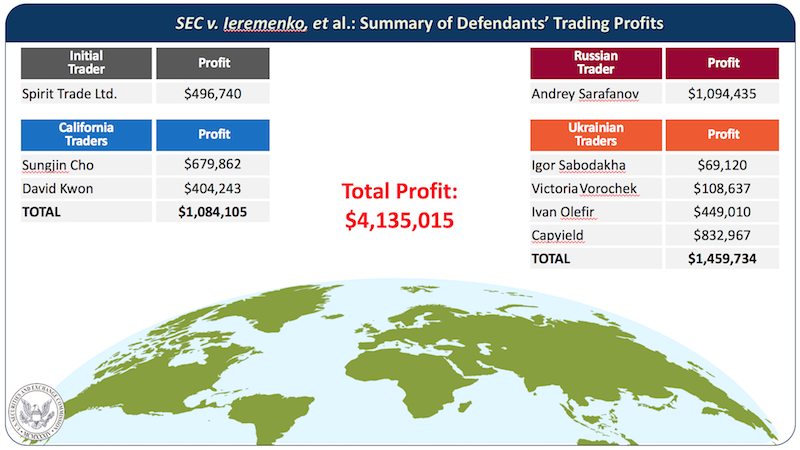
The SEC’s complaint alleges that after hacking the newswire services, Ukrainian hacker Oleksandr Ieremenko turned his attention to EDGAR and, using deceptive hacking techniques, gained access in 2016. Ieremenko extracted EDGAR files containing nonpublic earnings results. The information was passed to individuals who used it to trade in the narrow window between when the files were extracted from SEC systems and when the companies released the information to the public. In total, the traders traded before at least 157 earnings releases from May to October 2016 and generated at least $4.1 million in illegal profits.

SEC v. Ieremenko, et al.: Summary of Defendants’ Trading Profits

“International computer hacking schemes like the one we charged today pose an ever-present risk to organizations that possess valuable information,” said Enforcement Division Co-Director Stephanie Avakian. “Today’s action shows the SEC’s commitment and ability to unravel these schemes and identify the perpetrators even when they operate from outside our borders.”

“The trader defendants charged today are alleged to have taken multiple steps to conceal their fraud, including using an offshore entity and nominee accounts to place trades,” said Enforcement Division Co-Director Steven Peikin. “Our staff’s sophisticated analysis of the defendants’ trading exposed the common element behind their success, providing overwhelming evidence that each of them traded based on information hacked from EDGAR.”

The SEC’s complaint alleges that Ieremenko circumvented EDGAR controls that require user authentication and then navigated within the EDGAR system. Ieremenko obtained nonpublic “test files,” which issuers can elect to submit in advance of making their official filings to help make sure EDGAR will process the filings as intended. Issuers sometimes elected to include nonpublic information in test filings, such as actual quarterly earnings results not yet released to the public. Ieremenko extracted nonpublic test files from SEC servers, and then passed the information to different groups of traders.

The SEC’s complaint alleges that the following traders received and traded on the basis of the hacked EDGAR information:

• Sungjin Cho, Los Angeles, California
• David Kwon, Los Angeles, California
• Igor Sabodakha, Ukraine
• Victoria Vorochek, Ukraine
• Ivan Olefir, Ukraine
• Andrey Sarafanov, Russia
• Capyield Systems, Ltd. (owned by Olefir)
• Spirit Trade Ltd.

In a parallel action, the U.S. Attorney’s Office for the District of New Jersey today announced related criminal charges.

The SEC’s complaint charges each of the defendants with violating the federal securities antifraud laws and related SEC antifraud rules and seeks a final judgment ordering the defendants to pay penalties, return their ill-gotten gains with prejudgment interest, and enjoining them from committing future violations of the antifraud laws. The SEC also named and is seeking relief from four relief defendants who profited from the scheme when defendants used the relief defendants’ brokerage accounts to place illicit trades.

The SEC’s investigation, which is ongoing, was conducted by Market Abuse Unit and Cyber Unit staff David Bennett, Arsen Ablaev, Michael Baker, Jason Burt, Laura D’Allaird, Adam Gottlieb, James Scoggins, David Snyder, Jonathan Warner, Darren Boerner, and John Rymas, and IT Forensics staff Ken Zavos, Douglas Bond, Stephen Haupt, Gi Nguyen, and Jennifer Ross. The Division of Economic and Risk Analysis and the Office of Information Technology provided substantial assistance. The investigation was supervised by Robert Cohen, Joseph Sansone, and Carolyn Welshhans. Cheryl Crumpton and Stephan Schlegelmilch are leading the SEC’s litigation. The SEC appreciates the assistance of the U.S. Attorney’s Office for the District of New Jersey, the Federal Bureau of Investigation, and the U.S. Secret Service.


SEC Press Release

--- If you believe need help with a securities litigation, arbitration or litigation issue, email Mark Astarita or call 212-509-6544 to speak to a securities lawyer.

Wednesday, December 26, 2018

JPMorgan to Pay More Than $135 Million for Improper Handling of ADRs

The Securities and Exchange Commission today announced that JPMorgan Chase Bank N.A. will pay more than $135 million to settle charges of improper handling of “pre-released” American Depositary Receipts (ADRs).

ADRs – U.S. securities that represent foreign shares of a foreign company – require a corresponding number of foreign shares to be held in custody at a depositary bank.  The practice of “pre-release” allows ADRs to be issued without the deposit of foreign shares, provided brokers receiving them have an agreement with a depositary bank and the broker or its customer owns the number of foreign shares that corresponds to the number of shares the ADR represents. 

The SEC’s order found that JPMorgan improperly provided ADRs to brokers in thousands of pre-release transactions when neither the broker nor its customers had the foreign shares needed to support those new ADRs.  Such practices resulted in inflating the total number of a foreign issuer’s tradeable securities, which resulted in abusive practices like inappropriate short selling and dividend arbitrage that should not have been occurring. 

This is the eighth action against a bank or broker, and fourth action against a depositary bank, resulting from the SEC’s ongoing investigation into abusive ADR pre-release practices.  Information about ADRs is available in an SEC Investor Bulletin.

“With these charges against JPMorgan, the SEC has now held all four depositary banks accountable for their fraudulent issuances of ADRs into an unsuspecting market,” said Sanjay Wadhwa, Senior Associate Director of the SEC’s New York Regional Office.  “Our investigation continues into brokerage firms that profited by making use of these improperly issued ADRs.”

Without admitting or denying the SEC’s findings, JPMorgan agreed to pay disgorgement of more than $71 million in ill-gotten gains plus $14.4 million in prejudgment interest and a $49.7 million penalty for total monetary relief of more than $135 million.  The SEC’s order acknowledges JPMorgan’s cooperation in the investigation and remedial acts.

The SEC’s continuing investigation is being conducted by Philip A. Fortino, William Martin, Andrew Dean, Elzbieta Wraga, Joseph P. Ceglio, Richard Hong, and Adam Grace of the New York Regional Office, and is being supervised by Mr. Wadhwa. 


SEC Press Release

--- If you believe need help with a securities litigation, arbitration or litigation issue, email Mark Astarita or call 212-509-6544 to speak to a securities lawyer.

Friday, December 21, 2018

Agencies Invite Comment on a Proposal to Exclude Community Banks from the Volcker Rule

Five federal financial regulatory agencies on Friday invited public comment on a proposal that would exclude certain community banks from the Volcker Rule, consistent with the Economic Growth, Regulatory Relief, and Consumer Protection Act (EGRRCPA).

The Volcker Rule generally restricts banking entities from engaging in proprietary trading and from owning or sponsoring hedge funds or private equity funds.  The agencies are jointly proposing to exclude community banks with $10 billion or less in total consolidated assets and total trading assets and liabilities of 5 percent or less of total consolidated assets from the restrictions of the Volcker Rule.

Additionally, consistent with EGRRCPA, the proposal would, under certain circumstances, permit a hedge fund or private equity fund to share the same name or a variation of the same name with an investment adviser that is not an insured depository institution, company that controls an insured depository institution, or bank holding company.

The proposal was issued by the Federal Reserve Board, the Commodity Futures Trading Commission, the Federal Deposit Insurance Corporation, the Office of the Comptroller of the Currency, and the Securities and Exchange Commission.  Comments will be accepted for 30 days after publication in the Federal Register. 

# # #

Media Contacts: 

Federal Reserve Board

Eric Kollig

202-452-2955

CFTC

Donna Faulk-White

202-418-5080

FDIC

Julianne Breitbeil

202-898-6895

OCC

Bryan Hubbard

202-649-6870

SEC

Office of Public Affairs

202-551-4120


SEC Press Release

--- If you believe need help with a securities litigation, arbitration or litigation issue, email Mark Astarita or call 212-509-6544 to speak to a securities lawyer.

Martha Miller Named Advocate for Small Business Capital Formation

The Securities and Exchange Commission today announced that Martha Legg Miller has been named as the first Advocate for Small Business Capital Formation.

The position and the new Office of the Advocate for Small Business Capital Formation were created pursuant to the bipartisan SEC Small Business Advocate Act of 2016. As the Advocate for Small Business Capital Formation, Ms. Miller will oversee the office dedicated to continuing to advance the interests of small businesses and their investors at the SEC and in our capital markets. The office will, among other things, provide assistance to small businesses, conduct outreach to better understand the obstacles small businesses face when attempting to access the capital markets, and recommend improvements to the regulatory environment to help facilitate capital formation. Ms. Miller will report directly to the Commission and will work collaboratively with the many staff across the agency focused on helping small businesses access our capital markets in an efficient and cost-effective manner.

Ms. Miller, currently a partner at the Birmingham, Alabama, firm Balch & Bingham LLP, will assume her new role in January 2019. Ms. Miller has been at Balch & Bingham since 2012, where she represents private companies and investors across a spectrum of corporate transactions, including matters related to the financing of small- and medium-sized businesses. She also serves as an adviser for several organizations dedicated to helping start-ups, entrepreneurs, and small businesses, including several focused on women- and minority-owned companies and their investors. Ms. Miller has served these organizations in a variety of ways, including as a board member of an incubator and legal counsel to an angel investor network.

Chairman Jay Clayton and Commissioners Kara Stein, Robert Jackson, Hester Peirce, and Elad Roisman said, “We are excited for Martha to take on this new and important role. Martha’s extensive experience working with a diverse set of companies, entrepreneurs and investors – including in communities away from the coasts - will allow her to serve as a direct link to, and advocate for, the many small businesses around the country that drive our local and national economies for the benefit of Main Street investors.”

“Having spent my career working closely with a variety of businesses and their investors, I have a deep appreciation for the needs they face at different phases of their growth,” said Ms. Miller. “I am truly honored to have the opportunity to serve as the first Advocate for Small Business Capital Formation, where I will work alongside the many talented professionals at the SEC to encourage capital access for privately-held and smaller public companies. I look forward to the work ahead crafting solutions that meet the needs of businesses across the country.”

Ms. Miller holds bachelor’s degrees in Cognitive Neuroscience and Communication Studies from Vanderbilt University and a J.D. from the Georgetown University Law Center. 


SEC Press Release

--- If you believe need help with a securities litigation, arbitration or litigation issue, email Mark Astarita or call 212-509-6544 to speak to a securities lawyer.

Two Advisory Firms, CEO Charged With Mutual Fund Share Class Disclosure Violations

The Securities and Exchange Commission today announced settled charges against two New York-based investment advisers and the CEO of one of the advisers who selected mutual fund share classes inconsistent with their disclosures to clients. The firms and the CEO will collectively pay more than $1.8 million, which will be returned to harmed investors.

According to the SEC's orders, American Portfolios Advisers Inc., PPS Advisors Inc., and PPS's Chief Executive Officer and Chief Investment Officer, Lawrence Nicholas Passaretti, invested advisory clients in mutual fund share classes that paid 12b-1 fees to the firms' investment adviser representatives (IARs), even though less expensive share classes of the same funds were available. The orders find that American Portfolios and PPS failed to disclose conflicts of interest, violated their duty to seek best execution, and failed to implement policies and procedures designed to prevent violations of federal securities laws in connection with their mutual fund share class selection practices.  In particular, in disclosures to clients, American Portfolios incorrectly stated that its IARs either did not receive 12b-1 fees or only selected the more expensive share classes when less expensive share classes of the same fund were unavailable, while PPS incorrectly stated that it selected higher-cost share classes for the "long-term benefit" of clients and only where less expensive share classes of the same fund were unavailable.

"Advisers must be vigilant in disclosing all conflicts of interest arising from compensation received based on investment decisions made for clients," said C. Dabney O'Riordan, Chief of the SEC Enforcement Division's Asset Management Unit. "The documents these advisers provided to clients were incorrect and investors were harmed.  We are continuing our efforts to stop these violations and return money to harmed investors as quickly as possible."

The SEC's orders find that American Portfolios and PPS violated the antifraud and compliance provisions of federal securities laws, and that Passaretti caused PPS's violations. Without admitting or denying the findings, American Portfolios, PPS, and Passaretti consented to cease-and-desist orders, and American Portfolios and PPS consented to censures. American Portfolios agreed to pay $895,353 in disgorgement and prejudgment interest and a civil penalty of $250,000. PPS and Passaretti agreed to pay $631,746 in disgorgement and prejudgment interest and a civil penalty of $75,000. Collectively, the firms and Passaretti will pay more than $1.8 million, which will be distributed to harmed clients through Fair Funds.

American Portfolios and PPS were not eligible to self-report pursuant to the Division of Enforcement's Share Class Selection Disclosure Initiative announced in February because the Division contacted them about the disclosure violations before the initiative was announced.

The SEC's investigation was conducted by Vincent T. Hull and John Farinacci of the Asset Management Unit and Richard Hong of the New York Regional Office, with support from Cristina Giangrande, Karen Karakaya, Rachel Lavery, Gerard Sansobrino, and Dawn Blankenship of the Office of Compliance Inspections and Examinations of the New York Regional Office. The case was supervised by Panayiota K. Bougiamas of the Asset Management Unit.


SEC Press Release

--- If you believe need help with a securities litigation, arbitration or litigation issue, email Mark Astarita or call 212-509-6544 to speak to a securities lawyer.

SEC Charges Audit Firm and Suspends Accountants for Deficient Audits

The Securities and Exchange Commission today filed settled charges against national audit firm Crowe LLP, two of its partners, and two partners of a now-defunct audit firm for their significant failures in audits of Corporate Resource Services Inc., which went bankrupt in 2015 after the discovery of approximately $100 million in unpaid federal payroll tax liabilities. 

The SEC's order against Crowe finds that its audit team identified pervasive fraud risks in connection with its 2013 audit of Corporate Resource Services yet failed to:

  • Include procedures designed to detect the company's undisclosed payroll tax obligations;
  • Properly identify and audit the company's related-party transactions;
  • Obtain sufficient appropriate audit evidence to respond to these fraud risks, support recognition of revenue, and otherwise support the audit opinion; 
  • Evaluate substantial doubt about the  company's ability to continue as a going concern; and 
  • Conduct a proper engagement quality review.

The order also finds that Crowe was not independent as a result of an ongoing direct business relationship with Corporate Resource Services. According to the order, the audit deficiencies occurred despite the involvement of Crowe's national office, which was aware of the high-risk nature of the engagement and the inability to obtain appropriate evidence. The order also finds that Crowe's engagement partner, Joseph C. Macina, and engagement quality reviewer, Kevin V. Wydra, caused Crowe’s audit failures.

A related order finds that Mitchell J. Rubin and Michael Bernstein, former partners at Rosen, Seymour, Shapps, Martin & Co., LLP, engaged in fraud and performed a highly deficient audit of Corporate Resource Services' 2012 financial statements, which amounted to no audit at all, and that Bernstein caused the firm to lack the required independence when he failed to comply with partner rotation requirements.

"The audit standards are designed to ensure that public accounting firms have reasonable procedures to identify and respond to illegality and issues that pose material risks to the integrity of an issuer's financial statements," said Anita B. Bandy, Associate Director in the Division of Enforcement. "As set out in our order, the pervasive audit failures of Crowe and these accountants left investors with a misleading picture of Corporate Resource Services' financial condition."

The SEC's orders find that Crowe violated the audit requirement and accountant reporting provisions of the federal securities laws and that Macina and Wydra caused those violations. The orders find that Rubin and Bernstein violated the antifraud provisions and caused violations of the audit requirement and accountant reporting provisions of the federal securities laws. The orders also find that Crowe, Macina, Wydra, Rubin, and Bernstein caused Corporate Resource Services to violate the issuer reporting provisions of the federal securities laws. Additionally, the orders find that Crowe, Macina, Wydra, Rubin, and Bernstein engaged in improper professional conduct.

Crowe has agreed to pay a penalty of $1.5 million, be censured, and retain an independent compliance consultant to review its audit policies and procedures. Macina, Rubin, and Bernstein each agreed to pay a penalty of $25,000, and Wydra has agreed to pay a penalty of $15,000. Macina, Wydra, Rubin, and Bernstein agreed to be suspended from appearing and practicing before the SEC as an accountant, which includes not participating in the financial reporting or audits of public companies. The SEC's order permits Macina and Wydra to apply for reinstatement after three years and one year, respectively. Crowe, Macina, Wydra, Rubin, and Bernstein, who settled without admitting or denying the findings, also were ordered to cease and desist from future violations.

The SEC's investigation, which is continuing, has been conducted by Sharan K.S. Custer, Ernesto Amparo, Regina Barrett, and Kam Lee, and supervised by Ms. Bandy and Kristen Dieter.


SEC Press Release

--- If you believe need help with a securities litigation, arbitration or litigation issue, email Mark Astarita or call 212-509-6544 to speak to a securities lawyer.

SEC Staff Encourages Continued Engagement on Impact of MiFID II Research Provisions

Earlier this year, significant new rules relating to research became effective in the European Union (EU).  In an effort to assist market participants regarding their U.S.-regulated activities as they engage in efforts to comply with the EU’s Markets in Financial Instruments Directive (MiFID II), the staff of the U.S. Securities and Exchange Commission issued three related no-action letters. One letter, from the SEC’s Division of Investment Management, provided temporary no-action assurances under the Investment Advisers Act of 1940 to broker-dealers that receive payments in hard dollars or through MiFID-governed research payment accounts from MiFID-affected clients. These assurances expire on July 3, 2020.

In the year since MiFID II became effective, broker-dealers, investment advisers, issuers and other market participants have had an opportunity to observe the effects of MiFID II’s research provisions. During this time, SEC staff has also been monitoring and assessing the impact on the research marketplace and affected participants, including investment advisers and broker-dealers. As part of this effort, SEC staff continues to conduct industry outreach and engage with other regulators, including European authorities.  

“As the staff evaluates possible recommendations, it is invaluable to hear from a diverse group of market participants,” said SEC Chairman Jay Clayton. “In particular, it is important to have data and other information about how MiFID II's research provisions are affecting broker-dealers, investors and small, medium, and large issuers, including whether research availability has been adversely affected. Thank you to all who have been engaging with us on these issues.” 

We continue to encourage members of the public to provide data and other information relating to the effects of MiFID II's research provisions. 

Electronic submissions:

Use the SEC’s Internet submission form or send an e-mail to:IMMiFIDII@sec.gov

Comments would be appreciated by Jan. 31, 2019 so that they can be of greatest value in the staff’s evaluation of possible recommendations. In particular, data and information covering the period from MiFID II’s implementation to a recent date would be particularly useful.  


SEC Press Release

--- If you believe need help with a securities litigation, arbitration or litigation issue, email Mark Astarita or call 212-509-6544 to speak to a securities lawyer.

SEC Charges Two Robo-Advisers With False Disclosures

The Securities and Exchange Commission today instituted settled proceedings against two robo-advisers for making false statements about investment products and publishing misleading advertising.  The proceedings are the SEC’s first enforcement actions against robo-advisers, which provide automated, software-based portfolio management services.

An SEC order found that Redwood City, California-based Wealthfront Advisers LLC (formerly known as Wealthfront Inc.), a robo-adviser with over $11 billion in client assets under management, made false statements about a tax-loss harvesting strategy it offered to clients.  Wealthfront disclosed to clients employing its tax-loss harvesting strategy that it would monitor all client accounts for any transactions that might trigger a wash sale – which can diminish the benefits of the harvesting strategy – but failed to do so. Over a period of more than three years during which it made this disclosure, wash sales occurred in at least 31 percent of accounts enrolled in Wealthfront’s tax loss harvesting strategy. The SEC’s order also found that Wealthfront improperly re-tweeted prohibited client testimonials, paid bloggers for client referrals without the required disclosure and documentation, and failed to maintain a compliance program reasonably designed to prevent violations of the securities laws.

A separate SEC order found that New York City-based Hedgeable Inc., a robo adviser which had approximately $81 million in client assets under management, made a series of misleading statements about its investment performance.  According to the order, from 2016 until April 2017, Hedgeable posted on its website and social media purported comparisons of the investment performance of Hedgable’s clients with those of two robo-adviser competitors.  The performance comparisons were misleading because Hedgeable included less than 4 percent of its client accounts, which had higher-than-average returns.  Hedgable compared this with rates of return that were not based on competitors’ actual trading models.  The SEC’s order also found that Hedgeable failed to maintain required documentation and failed to maintain a compliance program reasonably designed to prevent violations of the securities laws.

“Technology is rapidly changing the way investment advisers are able to advertise and deliver their services to clients,” said C. Dabney O’Riordan, Chief of the SEC Enforcement Division’s Asset Management Unit.  “Regardless of their format, however, all advisers must take seriously their obligations to comply with the securities laws, which were put in place to protect investors.”  A bulletin published by SEC’s Office of Investor Education and Advocacy contains additional information about robo-advisers.

The SEC’s order against Wealthfront found that the adviser violated the antifraud, advertising, compliance, and other provisions of the Investment Advisers Act of 1940.  Without admitting or denying the SEC’s findings, Wealthfront consented to the entry of the SEC’s order censuring it, requiring it to cease and desist from further violations, and imposing a $250,000 penalty.

The SEC’s order against Hedgeable found that the adviser violated the antifraud, advertising, compliance, and books and records provisions of the Investment Advisers Act of 1940.  Without admitting or denying the SEC’s findings, Hedgeable consented to the entry of the SEC’s order censuring it, requiring it to cease and desist from further violations, and imposing an $80,000 penalty.

The SEC’s investigation regarding Wealthfront was conducted by Heather Marlow of the Asset Management Unit and Chrissy Filipp of the San Francisco Regional Office, and the case was supervised by Jeremy Pendrey.  The SEC’s investigation regarding Hedgeable was conducted by H. Gregory Baker of the Asset Management Unit, and the case was supervised by Panayiota K. Bougiamas.  Assisting in the Wealthfront matter were Alicia Minyen, Theresa Chalmers, Rhonda Fan, Michael Tomars, and Edward Haddad of the Office of Compliance Inspections and Examinations.  Assisting in the Hedgeable matter were George DeAngelis, Michael Paolo, Xiao Li, and Rachel Lavery of the Office of Compliance Inspections and Examinations. 


SEC Press Release

--- If you believe need help with a securities litigation, arbitration or litigation issue, email Mark Astarita or call 212-509-6544 to speak to a securities lawyer.

Thursday, December 20, 2018

SEC Office of Compliance Inspections and Examinations Announces 2019 Examination Priorities

The Securities and Exchange Commission's Office of Compliance Inspections and Examinations (OCIE) today announced its 2019 examination priorities. OCIE publishes its exam priorities annually to promote transparency of its examination program and provide insights into the areas it believes present potentially heightened risk to investors or the integrity of the U.S. capital markets. This year, particular emphasis will be on digital assets, cybersecurity, and matters of importance to retail investors, including fees, expenses, and conflicts of interest.   

"OCIE continues to thoughtfully approach its examination program, leveraging technology and the SEC staff's industry expertise,” said SEC Chairman Jay Clayton.  “As these examination priorities show, OCIE will maintain its focus on critical market infrastructure and Main Street investors in 2019.” 

“OCIE is steadfast in its commitment to protect investors, ensure market integrity and support responsible capital formation through risk-focused strategies that improve compliance, prevent fraud, monitor risk, and inform policy. We believe our ongoing efforts to improve risk assessment and maintain an open dialogue with market participants advance these goals to the benefit of investors and the U.S. capital markets,” said OCIE Director Pete Driscoll.

This year, OCIE's examination priorities are broken down into six categories: (1) compliance and risk at registrants responsible for critical market infrastructure; (2) matters of importance to retail investors, including seniors and those saving for retirement; (3) FINRA and MSRB; (4) digital assets; (5) cybersecurity; and (6) anti-money laundering programs. 

Compliance and Risks in Critical Market Infrastructure – OCIE will continue to examine entities that provide services critical to the proper functioning of capital markets. OCIE will conduct examinations of these firms which include, among others, clearing agencies, national securities exchanges, and transfer agents, focusing on certain aspects of their operations and compliance with recently effective rules. 

Retail Investors, Including Seniors and Those Saving for Retirement – Protecting Main Street investors continues to be a priority in 2019. OCIE will focus examinations on the disclosure and calculation of fees, expenses, and other charges investors pay, the supervision of representatives selling products and services to investors, broker-dealers entrusted with customer assets, and portfolio management and trading. 

FINRA and MSRB – OCIE will continue its oversight of FINRA by focusing examinations on FINRA's operations and regulatory programs and the quality of FINRA's examinations of broker-dealers and municipal advisors. OCIE will also examine MSRB to evaluate the effectiveness of select operations and internal policies, procedures, and controls.

Cybersecurity – Each of OCIE's examination programs will prioritize cybersecurity with an emphasis on, among other things, proper configuration of network storage devices, information security governance, and policies and procedures related to retail trading information security.  

Anti-Money Laundering Programs – Examiners will review for compliance with applicable anti-money laundering requirements, including whether firms are appropriately adapting their AML programs to address their regulatory obligations. 

The published priorities for 2018 are not exhaustive and will not be the only issues OCIE addresses in its examinations, Risk Alerts, and investor and industry outreach. While the priorities drive OCIE’s examinations, the scope of any examination is determined through a risk-based approach that includes analysis of the registrant’s operations, products offered, and other factors.  

The collaborative effort to formulate the annual examination priorities starts with feedback from examination staff, who are uniquely positioned to identify the practices, products, and services that may pose significant risk to investors or the financial markets. OCIE staff also seek advice of the Chairman and Commissioners, staff from other SEC divisions and offices, and the SEC's fellow regulators.

OCIE is responsible for conducting examinations of entities registered with the SEC, including more than 13,200 investment advisers, approximately 10,000 mutual funds and exchange traded funds, roughly 3,800 broker-dealers, about 330 transfer agents, seven active clearing agencies, 21 national securities exchanges, nearly 600 municipal advisors, FINRA, the MSRB, the Securities Investor Protection Corporation, and the Public Company Accounting Oversight Board, among others. The results of OCIE’s examinations are used by the SEC to inform rule-making initiatives, identify and monitor risks, improve industry practices, and pursue misconduct.


SEC Press Release

--- If you believe need help with a securities litigation, arbitration or litigation issue, email Mark Astarita or call 212-509-6544 to speak to a securities lawyer.

Wednesday, December 19, 2018

SEC Adopts Transaction Fee Pilot for NMS Stocks

The Securities and Exchange Commission today announced that it has voted to adopt new Rule 610T of Regulation NMS to conduct a Transaction Fee Pilot in NMS stocks. The pilot is designed to generate data that will help the Commission analyze the effects of exchange transaction fee and rebate pricing models on order routing behavior, execution quality, and market quality generally. Data from the Pilot will be used to facilitate an empirical evaluation of whether the exchange transaction-based fee and rebate structure is operating effectively to further statutory goals and whether there is a need for any potential regulatory action in this area.  

The Transaction Fee Pilot, which will apply to all stock exchanges, will create two test groups with new restrictions on the transaction fees and rebates that exchanges charge or offer to their broker-dealer members. One test group will prohibit exchanges from offering rebates and linked pricing and the other group will test a fee cap of $0.0010.  

"I applaud our staff for their thoughtful approach to the design of the Transaction Fee Pilot," said SEC Chairman Jay Clayton. "I expect the data provided by the pilot will help us make effective policy assessments that will benefit our markets and our investors. I would also like to thank former Commissioner Mike Piwowar for his contribution to this proposal during his time at the Commission, including while he was Acting Chairman. His work on market structure was extensive, and this pilot is only one example."

The Commission's action follows a recommendation from the Equity Market Structure Advisory Committee to conduct a pilot. The pilot will last for up to two years, and the Commission will subsequently announce by notice the commencement dates for data collection and the pilot period. Approximately one month prior to the beginning of the pilot period, the Commission will issue the list of pilot securities.

###

Fact Sheet

Transaction Fee Pilot

Dec. 19, 2018

Action

The Commission adopted new Rule 610T of Regulation NMS to establish a Transaction Fee Pilot in NMS stocks.  The Pilot will study the effects that exchange transaction fee and rebate pricing models may have on order routing behavior, execution quality, and market quality.  Data from the Pilot will be used to facilitate an empirical evaluation of whether the exchange transaction-based fee and rebate structure is operating effectively to further statutory goals and whether there is a need for any potential regulatory action in this area.  

Highlights

The key terms of the Pilot are summarized below.

Transaction Fee Pilot for NMS Stocks

Duration

2 years with an automatic sunset at 1 year unless, 

no later than 30 days prior to that time, the Commission publishes 

a notice that the pilot shall continue for up to 1 additional year; 

plus a 6-month pre-Pilot Period and 6-month  post-Pilot Period

Applicable Trading Centers

Equities exchanges (including maker-taker & taker-maker) 

but not ATSs or other non-exchange trading centers

Pilot Securities

NMS stocks with average daily trading volumes ≥ 30,000 shares with a share price ≥ $2 per share that do not close below $1 per share during the Pilot and that have an unlimited duration or a duration beyond the end of the post-Pilot Period

Group

# of NMS Stocks

Fee Cap

Rebates Permitted?

Pilot Design

Test Group 1

730

$0.0010 fee cap

for removing and providing displayed liquidity 
(no cap on rebates)

Yes

Test Group 2

730
(plus appended Canadian interlisted stocks)

Rule 610(c)$0.0030 cap continues to apply to fees for removing displayed liquidity

No

Rebates and Linked Pricing Prohibited for removing and providing displayed and undisplayed liquidity (except for specified market maker activity)

Control Group

Pilot Securities not in Test Groups 1 or 2

The Rule 610(c) cap continues to apply to fees for removing displayed liquidity (no cap on rebates)

Yes

Pilot Data

  1. Pilot Securities Exchange Lists and Pilot Securities Change Lists
  1. Exchange Transaction Fee Summary 
  1. Order Routing Datasets

The Pilot will require the national securities exchanges to prepare and post on their public websites in standardized XML format transaction fee and rebate data on a monthly basis. Primary listing exchanges also will be required to post on their websites information about the Pilot securities they list and any changes to those securities. In addition, the Pilot will require the national securities exchanges to prepare and provide to the Commission, on a monthly basis, aggregated order routing data. 

What’s Next?

The rule will be published on the Commission’s website and in the Federal Register and will become effective 60 days from the date of publication in the Federal Register. The Commission will subsequently announce by notice the commencement dates for the pre-Pilot, Pilot, and post-Pilot Periods. Approximately one month prior to the beginning of the Pilot Period, the Commission will issue the List of Pilot Securities, which will include the securities in the Pilot and their Test Group assignments.


SEC Press Release

--- If you believe need help with a securities litigation, arbitration or litigation issue, email Mark Astarita or call 212-509-6544 to speak to a securities lawyer.

SEC Adopts Final Rules to Allow Exchange Act Reporting Companies to Use Regulation A

The Securities and Exchange Commission adopted final rules to allow reporting companies to rely on the Regulation A exemption from registration for their securities offerings.  

"Regulation A provides an exemption from registration under the Securities Act for offerings of securities up to $50 million in a 12-month period," said Chairman Jay Clayton. "The amended rules will provide reporting companies additional flexibility when raising capital."

The amendments, mandated by the Economic Growth, Regulatory Relief, and Consumer Protection Act, will enable companies that are subject to the reporting requirements of Section 13 or 15(d) of the Securities Exchange Act of 1934 to use Regulation A. The amendments also permit such reporting companies to meet their Regulation A ongoing reporting obligations through their Exchange Act reports. 

*   *   *

FACT SHEET
Amendments to Regulation A
Dec. 19, 2018

Action

Regulation A provides an exemption from registration under the Securities Act of 1933 for offerings of securities up to $50 million in a 12-month period.  Currently, Regulation A is not available to companies that are Exchange Act reporting companies. The Economic Growth, Regulatory Relief, and Consumer Protection Act, enacted earlier this year, required the Commission to revise Regulation A to allow reporting companies to use the exemption.  

The final rules amend Securities Act Rule 251 to permit companies subject to the reporting requirements of Section 13 or 15(d) of the Exchange Act to use Regulation A. The final rules also revise Securities Act Rule 257 to provide that companies that meet the reporting requirements of the Exchange Act will be deemed to have met the reporting requirements of Regulation A. 

In connection with these amendments, the Commission also made other conforming changes to Regulation A and Form 1-A.  

What’s Next?

The amendments to Regulation A will become effective upon publication in the Federal Register.


SEC Press Release

--- If you believe need help with a securities litigation, arbitration or litigation issue, email Mark Astarita or call 212-509-6544 to speak to a securities lawyer.

SEC Charges Additional 13 Unregistered Brokers Who Sold Woodbridge Securities to Retail Investors

The Securities and Exchange Commission today announced charges against an additional 13 individuals and 10 companies for unlawfully selling securities of Woodbridge Group of Companies LLC to retail investors. Woodbridge collapsed into bankruptcy in December 2017 and the SEC previously charged the company, its owner and others with operating a $1.2 billion Ponzi scheme and charged five of the top Florida-based sales agents for securities and broker-dealer registration violations.

The 13 individual defendants charged were among Woodbridge’s top revenue producers, selling more than $350 million of its unregistered securities to more than 4,400 investors. According to the complaints, the defendants marketed Woodbridge’s securities as a “safe” and “secure” investment and reaped millions of dollars in commissions on their sales even though they were not registered as, or associated with, registered broker-dealers. The SEC also alleges that defendant Jordan Goodman, a self-described “media influencer,” touted Woodbridge without disclosing that he was paid to do so.

“The SEC has now charged 18 of Woodbridge’s highest-earning unregistered sales agents who sold more than $400 million of its securities to retail investors,” said Eric I. Bustillo, Director of the SEC’s Miami Regional Office. “Our continuing investigation of Woodbridge seeks to hold those who aided this massive fraud accountable and to return funds to harmed investors.”

In its latest actions, the SEC is seeking court-ordered injunctions, return of allegedly ill-gotten gains with interest, and financial penalties against Robert S. “Lute” Davis, Jr., Donald Anthony Mackenzie, Jordan E. Goodman, Aaron R. Andrew, Jeffrey L. Wendel, Alan H. New, David N. Knuth, Randy T. Rondberg, Richard Fritts, Marcus Bradford Bray, Gregory W. Anderson, Claude Steven Mosley, Gregory A. Koch, and their companies Old Security Financial Group Inc., Paramount Financial Services Inc. d/b/a Live Abundant, Wendel Financial Network LLC, Synergy Investment Services LLC, Trager LLC, Fritts Financial LLC, Bradford Solutions LLC, Balanced Financial Inc., Security Financial LLC, and Koch Insurance Brokers LLC.

Goodman settled the SEC’s charges without admitting or denying the allegations and agreed to disgorgement of $2.29 million plus prejudgment interest of $315,850 and a $100,000 penalty, and to be subject to an injunction and industry and penny stock bars. Synergy Investment Services, New, and Knuth settled the SEC’s charges without admitting or denying the allegations with the court to determine disgorgement, interest, and penalties at a later date.

The SEC also reached settlements in its previously filed action against Florida-based sales agents Barry M. Kornfeld, Ferne Kornfeld, and Albert D. Klager. Without admitting or denying the allegations, the three agreed to a permanent injunction and industry and penny-stock bars. The Kornfelds agreed to disgorgement of $3.69 million plus $690,497 in prejudgment interest. Additionally, Barry Kornfeld agreed to a $500,000 penalty and Ferne Kornfeld agreed to a $150,000 penalty.  Klager agreed to $1.36 million in disgorgement, $278,908 in prejudgment interest, and a $100,000 penalty. 

The SEC’s investigation has been conducted by Scott A. Lowry, Russell Koonin, Christine Nestor, and Mark Dee in the Miami Regional Office, and supervised by Jason R. Berkowitz and Fernando Torres. The litigation will be led by Ms. Nestor, Mr. Koonin, and Mr. Lowry under the supervision of Andrew O. Schiff.  The SEC appreciates the assistance of the Texas State Securities Board, Florida Office of Financial Regulation, Arizona Corporation Commission - Securities Division, California Office of the Attorney General and the Department of Business Oversight, Colorado Division of Securities, Pennsylvania Department of Banking and Securities - Bureau of Securities Compliance and Examinations, Utah Department of Commerce - Division of Securities, and the Financial Industry Regulatory Authority.

The SEC’s Office of Investor Education and Advocacy has issued an Investor Alert to help seniors identify signs of investment fraud and, in conjunction with the Division of Enforcement’s Retail Strategy Task Force, another Investor Alert about Ponzi schemes targeting seniors.  The SEC strongly encourages investors to use the agency’s Investor.gov website to check the backgrounds of people selling them investments to quickly identify whether they are registered professionals.


SEC Press Release

--- If you believe need help with a securities litigation, arbitration or litigation issue, email Mark Astarita or call 212-509-6544 to speak to a securities lawyer.

SEC Proposes Rule Changes for Fund of Funds Arrangements

The Securities and Exchange Commission today voted to propose a new rule and related amendments designed to streamline and enhance the regulatory framework for fund of funds arrangements. Funds of funds are created when a mutual fund or other type of fund invests in shares of another fund.

"Mutual funds, exchange-traded funds (ETFs) and other types of funds have become increasingly important for Main Street investors to save for retirement and meet their other financial goals," said SEC Chairman Jay Clayton. "These funds invest in other funds for a variety of reasons, including to achieve asset allocation or diversification in an efficient manner, as well as to hedge and otherwise manage risk.  However, depending on the size of the investments, funds may be required to seek an exemptive order, causing costs and delays, and resulting in a regulative regime where substantially similar fund of funds arrangements may be subject to different conditions. This proposal would create a consistent, rules-based framework for fund of funds arrangements while providing robust protections for investors."

The Commission's proposal would allow a fund to acquire the shares of another fund in excess of the limits of the Investment Company Act without obtaining an individual exemptive order from the Commission. In order to rely on the rule, funds must comply with conditions designed to enhance investor protection, including conditions restricting funds' ability to improperly influence other funds, charge excessive fees, or create overly complex fund of funds structures.

Because the proposed rule would create a new, comprehensive exemptive rule for funds of funds to operate, the Commission is proposing to rescind rule 12d1-2 as well as most exemptive orders permitting fund of funds arrangements.

The SEC will seek public comment on the proposal for 90 days.

###

FACT SHEET

Fund of Funds Rule Proposal

SEC Open Meeting

Dec. 19, 2018

Action

The Commission is proposing a new rule and amendments under the Investment Company Act of 1940 designed to streamline and enhance the regulatory framework for funds that invest in other funds ("fund of funds" arrangements).  The Commission also is proposing to rescind rule 12d1-2 under the Act and most exemptive orders granting relief from sections 12(d)(1)(A), (B), (C), and (G) of the Act.  Finally, the Commission is proposing related amendments to rule 12d1-1 under the Act and Form N-CEN. This proposal reflects the Commission's decades of experience with fund of funds arrangements and would create a consistent and efficient rules-based regime for the formation and oversight of funds of funds.

Highlights of the Proposal

Proposed Rule 12d1-4

Proposed rule 12d1-4 would permit a registered investment company or business development company (referred to as "acquiring funds") to acquire the securities of any other registered investment company or business development company (referred to as "acquired funds") in excess of the limits in section 12(d)(1) of the Investment Company Act of 1940. While the proposed rule is based on the Commission's current exemptive orders permitting fund of funds arrangements, it is tailored to enhance investor protections while providing funds with flexibility to meet their investment objectives in an efficient manner. The proposed rule's conditions include the following:

  • Control and Voting. Proposed rule 12d1-4 would prohibit an acquiring fund from controlling an acquired fund and would require an acquiring fund that holds more than 3 percent of an acquired fund's outstanding voting securities to vote those securities in a prescribed manner in order to minimize the influence that an acquiring fund may exercise over an acquired fund.  An acquiring fund that is part of the same fund group as the acquired fund and an acquiring fund that has a sub-adviser that acts as adviser to the acquired fund would not be subject to the control and voting conditions.
  • Redemption Limits. To address concerns that an acquiring fund could threaten large-scale redemptions as a means to exert undue influence over an acquired fund, the proposed rule would prohibit an acquiring fund that acquires more than 3 percent of an acquired fund's outstanding shares from redeeming more than 3 percent of the acquired fund's total outstanding shares in any 30-day period.
  • Excessive Fees. The proposed rule includes conditions designed to prevent duplicative and excessive fees in fund of funds arrangements by requiring an evaluation of aggregate fees associated with the investment in the acquired fund and the complexity of the fund of funds arrangement.
  • Complex Structures. To limit funds' ability to use fund of funds arrangements to create overly complex structures, proposed rule 12d1-4 generally would prohibit funds from creating three-tier fund of funds structures, except in certain limited circumstances.

Proposed Rescission of Rule 12d1-2 and Certain Exemptive Relief, and 
Proposed Amendments to Rule 12d1-1

To help create a consistent and streamlined regulatory framework for fund of funds arrangements, the Commission also proposes several related actions:

  • Proposed Rescission of Rule 12d1-2 and Certain Exemptive Relief.  The Commission is proposing to rescind rule 12d1-2, which permits funds that primarily invest in funds within the same fund group to invest in unaffiliated funds and non-fund assets. The Commission also is proposing to rescind the Commission's exemptive orders permitting fund of funds arrangements, with limited exceptions. As a result, funds wishing to create certain types of fund of funds arrangements that exceed the statutory limitations would be required to rely on proposed rule 12d1-4 and comply with its associated conditions.
  • Proposed Amendments to Rule 12d1-1.  The proposal also recommends amending rule 
    12d1-1 to allow funds that primarily invest in funds within the same fund group to continue to invest in unaffiliated money market funds.

Proposed Amendments to Form N-CEN

The proposal also includes amendments to Form N-CEN to require funds to report whether they relied on rule 12d1-4 or the statutory exception in section 12(d)(1)(G) of the Investment Company Act during the applicable reporting period.

What’s Next?

The comment period for the proposed rule and amendments will be 90 days after publication in the Federal Register.


SEC Press Release

--- If you believe need help with a securities litigation, arbitration or litigation issue, email Mark Astarita or call 212-509-6544 to speak to a securities lawyer.

SEC Proposes Risk Mitigation Techniques for Uncleared Security-Based Swaps

The Securities and Exchange Commission today voted to propose rules requiring the application of risk mitigation techniques to portfolios of uncleared security-based swaps.  Proposed Rules 15Fi-3 through 15Fi-5 would establish requirements for registered security-based swap dealers and major security-based swap participants (SBS Entities) with respect to:

  • Reconciling outstanding security-based swaps with applicable counterparties on a periodic basis.
  • Engaging in certain forms of portfolio compression exercises, as appropriate.
  • Executing written security-based swap trading relationship documentation with each of its counterparties prior to, or contemporaneously with, executing a security-based swap transaction.

Relationship documentation, portfolio reconciliation, and portfolio compression are important tools for increasing operational efficiency and reducing risk for SBS Entities.  For example, requiring SBS Entities to document the terms of their trading relationship with each of their counterparties before executing a new security-based swap transaction should foster greater transparency and legal certainty by allowing market participants to have a clear understanding of each other’s rights and obligations from the outset of the transaction.  Portfolio reconciliation further supports these goals by providing counterparties with a mechanism for identifying any discrepancies in the terms of a transaction throughout the life of the trade.  Finally, portfolio compression allows market participants to reduce their total number of open contracts – generally without affecting their net exposure – resulting in fewer trades to manage, maintain, and settle, and fewer opportunities for processing errors.

By proposing these rules, the Commission is taking another step in standing up its regime pursuant to Title VII of the Dodd-Frank Wall Street Reform and Consumer Protection Act, and demonstrating its continued commitment to sound and efficient regulation of markets. 

“These are a series of common sense rules that should aid all participants in our swaps markets improve operational efficiency and reduce back-office risks,” said SEC Chairman Jay Clayton.  “I am also pleased that we were able to craft these rules in a manner that further harmonizes the Commission’s requirements applicable to security-based swap dealers and major security-based swap participants with the corresponding requirements applicable to CFTC-regulated entities.”

*  *  *

FACT SHEET

Risk Mitigation Techniques for Uncleared Security-Based Swaps 


Action

The Securities and Exchange Commission today announced that it has voted to propose Rules 15Fi-3 through 15Fi-5 under the Securities Exchange Act of 1934 (Exchange Act) that, if adopted, would require the application of specific risk mitigation techniques to portfolios of security-based swaps not submitted for clearing to a central counterparty.  Specifically, the proposal would establish requirements for each registered security-based swap dealer or major security-based swap participant (collectively, an “SBS Entity”) with respect to, among other things, (1) reconciling outstanding security-based swaps with applicable counterparties on a periodic basis, (2) engaging in certain forms of portfolio compression exercises, as appropriate, and (3) executing written security-based swap trading relationship documentation with each of its counterparties prior to, or contemporaneously with, executing a security-based swap transaction.

Highlights

Proposed Rule 15Fi-3: Portfolio Reconciliation

  • Under the proposal, the term “portfolio reconciliation” would be defined to mean the process by which the two parties to one or more security-based swaps:
    • Exchange the terms of all security-based swaps in the security-based swap portfolio between the counterparties.
    • Exchange each counterparty’s valuation of all outstanding security-based swaps entered into between the counterparties as of the close of business on the immediately preceding business day.
    • Resolve any discrepancy in valuations or material terms.
  • For purposes of the above definition, the term “material terms” would be defined to include:
    • With respect to any security-based swap that has not yet been previously reconciled pursuant to proposed Rule 15Fi-3, each term that is required to be reported to a registered swap data repository (“SDR”) or the Commission pursuant to Regulation SBSR.
    • With respect to all other security-based swaps, each term that is required to be reported to a registered swap data repository or the Commission pursuant to Regulation SBSR; provided, however, that such definition would not include any term that is not relevant to the ongoing rights and obligations of the parties and the valuation of the security-based swap.
  • Proposed Rule 15Fi-3(a) would apply to security-based swap portfolios between two SBS Entities as follows:
    • The SBS Entity counterparties would be required to engage in portfolio reconciliation no less frequently than:
      • Each business day for each portfolio that includes 500 or more security-based swaps.
      • Weekly for each portfolio that includes more than 50 but fewer than 500 security-based swaps on the business day during any week.
      • Quarterly for each portfolio that includes no more than 50 security-based swaps at any time during the calendar quarter.
    • Any discrepancy in a material term (other than with respect to valuation) must be resolved immediately.
    • Valuation discrepancies of ten percent or greater of the higher valuation must be resolved as soon as possible, but in any event within five business days of identifying the discrepancy.
  • Proposed Rule 15Fi-3(b) would apply to security-based swap portfolios between an SBS Entity and a counterparty who is not an SBS Entity as follows:
    • The SBS Entity would be required to establish, maintain, and enforce written policies and procedures reasonably designed to ensure that it engages in portfolio reconciliation no less frequently than:
      • Quarterly for each portfolio that includes more than 100 security-based swaps at any time during the calendar quarter.
      • Annually for each portfolio that includes no more than 100 security-based swaps at any time during the calendar year.
    • The policies and procedures also must provide that any discrepancy in the valuation or in a material term must be resolved in a “timely fashion.”
  • Proposed Rule 15Fi-3(c) would create a reporting obligation in the event of certain unresolved security-based swap valuation disputes.
    • Specifically, an SBS Entity would be required to promptly notify the Commission of any security-based swap valuation dispute in excess of $20,000,000, at either the transaction or portfolio level, if not resolved within:
      • Three (3) business days, if the dispute is with a counterparty that is an SBS Entity.
      • Five (5) business days, if the dispute is with a counterparty that is not an SBS Entity.

Proposed Rule 15Fi-4: Portfolio Compression

  • Proposed Rule 15Fi-4(a) would apply to security-based swap portfolios between two SBS Entities, and would require each SBS Entity to establish, maintain, and follow written policies and procedures for:
    • Evaluating bilateral and multilateral portfolio compression exercises that are initiated, offered, or sponsored by any third party.
    • Periodically engaging in both bilateral portfolio compression exercises and multilateral portfolio compression exercises, in each case when appropriate, with its SBS Entity counterparties.
    • Terminating each fully offsetting security-based swap with its SBS Entity counterparties in a timely fashion, when appropriate.
  • Proposed Rule 15Fi-4(b) would apply to security-based swap portfolios between an SBS Entity and a counterparty who is not an SBS Entity, and would require the SBS Entity to establish, maintain, and follow written policies and procedures for periodically terminating fully offsetting security-based swaps and for engaging in bilateral or multilateral portfolio compression exercises with the applicable counterparty, when appropriate and to the extent requested by any such counterparty

Proposed Rule 15Fi-5: Trading Relationship Documentation

  • Proposed Rule 15Fi-5(a)(2) would require each SBS Entity to establish, maintain, and enforce written policies and procedures reasonably designed to ensure that it executes written security-based swap trading relationship documentation with each of its counterparties (regardless of whether the counterparty is an SBS Entity) prior to, or contemporaneously with, executing a security-based swap with such counterparty.
  • Pursuant to proposed Rules 15Fi-5(b)(1) and (3), the applicable policies and procedures would need to:
    • Require that the security-based swap trading relationship documentation be in writing, and that it include all terms governing the trading relationship between the SBS Entity and its counterparty, including, without limitation, terms addressing payment obligations, netting of payments, events of default or other termination events, calculation and netting of obligations upon termination, transfer of rights and obligations, allocation of any applicable regulatory reporting obligations (including pursuant to Regulation SBSR), governing law, valuation, and dispute resolution.
    • Require that the security-based swap trading relationship documentation include credit support arrangements, which would be required to address certain margin-related matters identified in the proposed rule.
  • Proposed Rule 15Fi-5(b)(4) would require that the applicable policies and procedures provide that the relevant swap trading relationship documentation between certain specified types of financial counterparties include written documentation in which the parties agree on the process, which may include any agreed upon methods, procedures, rules, and inputs, for determining the value of each security-based swap at any time from execution to the termination, maturity, or expiration of such security-based swap.
    • Such valuation methodology would be for the purposes of complying with the margin requirements under Section 15F(e) of the Exchange Act (and applicable regulations), and the risk management requirements under Section 15F(j) of the Exchange Act (and applicable regulations).
    • The rule also specifies that an SBS Entity would not be required to disclose to the counterparty confidential, proprietary information about any model it may use to value a security-based swap.
  • Proposed Rules 15Fi-5(b)(5) and (6) would require that the policies and procedures governing the applicable trading relationship documentation require SBS Entities to disclose certain information to their counterparties regarding both their legal status and the status of the security-based swap.
  • Proposed Rule 15Fi-5(c) would require each SBS Entity to have an independent auditor conduct periodic audits sufficient to identify any material weakness in its documentation policies and procedures required by the rule.

Other Highlights

  • The release also requests comment on whether certain aspects of the proposed rules, if adopted, could provide the factual predicate for allowing an SDR to potentially satisfy its obligations under Section 13(n)(5)(B) of the Exchange Act and Rule 13n-4(b)(3) thereunder to verify the terms of each security-based swap with both counterparties.
  • The Commission also proposes to treat the proposed rules as entity-level requirements that apply to an SBS Entity’s entire security-based swap business without exception, including in connection with any security-based swap business it conducts with foreign counterparties.
  • Finally, the release contains proposed amendments to Rule 3a71-6 to address the potential availability of substituted compliance in connection with proposed Rules 15Fi-3 through 15Fi-5.

Next Steps

The Commission will seek public comment on the proposed rules and rule amendments for 60 days following publication in the Federal Register.


SEC Press Release

--- If you believe need help with a securities litigation, arbitration or litigation issue, email Mark Astarita or call 212-509-6544 to speak to a securities lawyer.

SEC Adopts Rule of Practice 194

The Securities and Exchange Commission today announced that it has voted to adopt Rule of Practice 194.  In general, this rule creates a transparent, efficient, and comprehensive process for a registered security-based swap dealer or major security-based swap participant, collectively known as SBS Entities, to apply to the Commission for relief from the statutory disqualification prohibition found in Exchange Act Section 15F(b)(6).  Rule of Practice 194 also provides an exclusion for an SBS Entity from the prohibition in Exchange Act Section 15F(b)(6) with respect to associated persons entities, consistent with the Commodity Futures Trading Commission’s (CFTC) approach with respect to the statutory prohibition for swap entities. 

“Not only does adopting Rule of Practice 194 mark a significant milestone in the SEC’s implementation of Title VII of the Dodd-Frank Act, but like the Commission’s recent issuance of a Statement concerning certain provisions of its business conduct standards for SBS Entities, Rule of Practice 194 further reflects the Commission staff’s shared commitment with their counterparts at the CFTC, to achieve greater harmonization of Title VII rules,” said SEC Chairman Jay Clayton. 

*  *  *

FACT SHEET

Applications by Security-Based Swap Dealers or Major Security-Based Swap Participants for Statutorily Disqualified Associated Persons to Effect or Be Involved in Effecting Security-Based Swap Transactions (Rule of Practice 194)

Action

The Securities and Exchange Commission has adopted Rule of Practice 194, which creates a process for a registered SBS Entity to apply to the Commission for an order permitting an associated person that is a natural person who is subject to a statutory disqualification to effect or be involved in effecting security-based swaps on behalf of the SBS Entity if the Commission finds, subject to certain conditions, that such association is consistent with the public interest.  Rule of Practice 194 also provides an exclusion for an SBS Entity from the prohibition in Exchange Act Section 15F(b)(6) with respect to associated persons entities. 

Background

In 2010, Congress passed Title VII of the Dodd-Frank Wall Street Reform and Consumer Protection Act (the “Dodd-Frank Act”), which established a comprehensive framework for regulating the over-the-counter swaps markets.  Section 764 of the Dodd-Frank Act, among other things, added Section 15F(b)(6) to the Exchange Act, which makes it unlawful, unless otherwise provided by rule, regulation or order of the Commission, for an SBS Entity to permit an associated person who is subject to a statutory disqualification to effect or be involved in effecting security-based swaps on behalf of the SBS Entity if the SBS Entity knew, or in the exercise of reasonable care should have known, of the statutory disqualification.

On August 5, 2015, the Commission proposed Rule of Practice 194 to establish a process by which an SBS Entity could apply to the Commission to permit an associated person who is subject to a statutory disqualification to effect or be involved in effecting security-based swaps on behalf of the SBS Entity.   As discussed in the Commission’s proposal, the federal securities laws provide various procedural avenues that allow certain registered entities to associate, where warranted, with persons subject to a statutory disqualification or other bar, including for example the Commission’s Rule of Practice 193 and FINRA’s eligibility proceedings.  The Commission modeled proposed Rule of Practice 194 on these existing processes.  The Commission requested comment on all aspects of the proposal as well as two alternative approaches, and received comments in response.

Highlights

The Commission is adopting Rule of Practice 194 largely as proposed, with certain modifications.  In particular, the Commission is adopting the following provisions in Rule of Practice 194:

  • Paragraph (a) of Rule of Practice 194, which defines the scope of the rule and provides a process for submitting applications by an SBS Entity seeking an order of the Commission to permit an associated person that is a natural person who is subject to a statutory disqualification to effect or be involved in effecting security-based swaps on behalf of the SBS Entity.
  • Paragraph (b) of Rule of Practice 194, which specifies the required showing for an application. For the Commission to issue an order granting relief under Rule of Practice 194, an SBS Entity is required to make a showing that it would be consistent with the public interest to permit the associated person to effect or be involved in effecting security-based swaps on behalf of the SBS Entity, notwithstanding the statutory disqualification.
  • Paragraph (c) of Rule of Practice 194, which establishes an exclusion from the general prohibition in Exchange Act Section 15F(b)(6) with respect to all associated person entities.
  • Paragraphs (d) and (e) of Rule of Practice 194, which specify the form of the application with respect to an associated person that is a natural person and the items to be addressed in the written statement with the application.
  • Paragraph (f) of Rule of Practice 194, which requires an applicant to provide as part of any application any order, notice or other applicable document reflecting the grant, denial, or other disposition (including any dispositions on appeal) of any prior application concerning the associated person under Rule of Practice 194 and other similar processes.
  • Paragraph (g) of Rule of Practice 194, which provides for notice to the applicant in cases where the Commission staff anticipates making an adverse recommendation to the Commission with respect to an application made pursuant to this rule. In such cases, the applicant will be provided with a written statement of the reasons for the Commission staff’s preliminary recommendation, and the applicant will have 30 days to submit a written statement in response.
  • Paragraph (h) of Rule of Practice 194, which provides that, where certain conditions are met, an SBS Entity does not need to file an application under Rule of Practice 194 to permit a statutorily disqualified associated person to effect or be involved in effecting security-based swaps on behalf of the SBS Entity. Specifically, paragraph (h) of Rule of Practice 194 allows an SBS Entity, subject to certain conditions, to permit a statutorily disqualified associated person to effect or be involved in effecting security-based swaps on behalf of the SBS Entity without making an application to the Commission, where the Commission, CFTC, an SRO (g., FINRA), or a registered futures association (e.g., the NFA) has granted a prior application or otherwise granted relief from a statutory disqualification with respect to that associated person.  In such cases where an SBS Entity meets the requirements of paragraph (h), the SBS Entity will be permitted to file a notice with the Commission (in lieu of an application).

Next Steps

Rule of Practice 194 is effective 60 days after publication in the Federal Register.  However, the compliance date for the SBS Entity registration rules depends on the adoption of two pending rules, and will be the later of:  six months after the date of publication in the Federal Register of a final rule release adopting rules establishing capital, margin and segregation requirements for SBS Entities or the compliance date of final rules establishing recordkeeping and reporting requirements for SBS Entities.


SEC Press Release

--- If you believe need help with a securities litigation, arbitration or litigation issue, email Mark Astarita or call 212-509-6544 to speak to a securities lawyer.